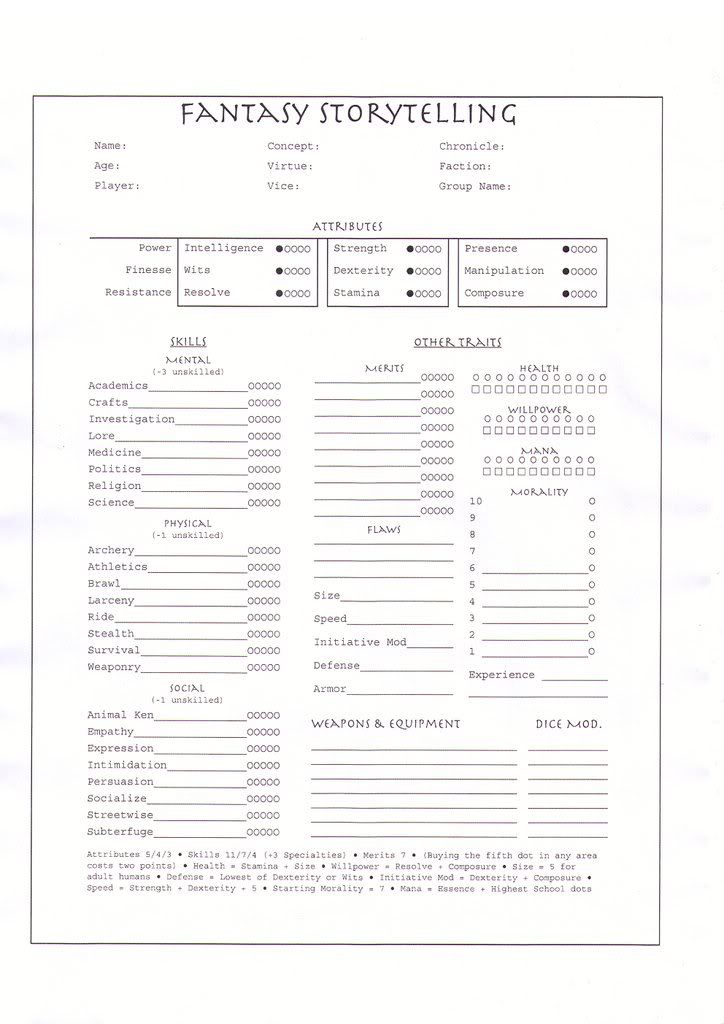
It's discussed HERE.
The original site has been down for some time now, but Yours Truly has saved the info:
Code: Select all
Storytelling System Adaptation
The following is a list of suggested modifications to the Storytelling system as detailed in the World of
Darkness rule book published by White Wolf. These rules are intended for Fantasy Roleplaying with the
Storytelling system.
Download the Fantasy Storytelling character sheet.
Table of Contents
1. Skills
2. Merits
3. Equipment
4. Weapons
5. Magic
6. Races
7. Revision History
8. TODO List
Skills
The following Skills are not available in most medieval fantasy settings:
Drive
Computer
The following skills have been renamed or adapted. See descriptions below for details:
Firearms (changed to Archery)
Occult (changed to Lore)
The following section describes new Skills introduced for typical medieval settings. These include Lore,
Religion, Archery, and Ride. In addition, details are provided for application of the Crafts Skill to
Alchemy and Enchanting Items.
Mental Skills
Crafts: Alchemy
Dice Pool: Intelligence + Crafts + equipment
Action: Extended (4-10 successes; one roll equals 10 minutes of work)
Combinations of herbs and liquids to create concoctions of a beneficial (or harmful) nature is as old
as mankind. Changing lead into gold is another matter entirely. The storyteller has final say over
what can be created using alchemy and whether magical aptitude is required or not, but in general,
simple potions require only the necessary materials, time, Crafts skill, and a bottle.
Roll Results
Dramatic Failure: There's a terrible accident and the fluid explodes, ruining the potion and
causing one bashing damage to the alchemist.
Failure: Your character makes no headway in his project.
Success: Your character makes progress in his project.
Dramatic Success: Your character makes dramatic progress in his project, likely well ahead
of schedule.
Suggested Equipment: Beaker/flasks (+1), burner (+1), alchemist kit (+2), alchemist lab (+3)
Crafts: Enchanting Items
Dice Pool: Crafts + Magic School + equipment
Action: Extended (successes and time vary based on complexity, at storyteller's discretion)
Creating an enchanted item is a laborious process involving complex magical rituals and rare,
expensive materials. The types of items created must be related to the school(s) of magic known by
the character(s) involved in the creation. As a general rule, one success is required per week of
work to continue making progress on an item, and most items take months to complete.
Roll Results
Dramatic Failure: There's a terrible accident and the object is destroyed by the magical
energies she wields.
Failure: Your character makes no headway in his project.
Success: Your character makes progress in his project.
Dramatic Success: Your character makes dramatic progress in his project, likely well ahead
of schedule.
Suggested Equipment: Gem-cutting tools (+1), enchanting wand (+1), enchanter laboratory (+3)
Science
Similiar mechanically to the Science Skill, this Skill instead applies to medieval antiquated sciences such
as alchemy, astrology, astronomy, brewing, cooking, and metallurgy.
Lore
See Occult, Lore is a generalization of this Skill for fantasy settings. In addition to supernatural
knowledge, this skill reflects your character's knowledge of traditions and oral history passed down
through the generations, such as mythology or mystic knowledge not typically obtained through formal
study. Mechanically, it is identical to Occult.
Religion
Your character possesses a depth of knowledge about rituals, rites, and traditions of religion.
Beyond just personal faith, he understands the traditions that guide organized religion and the
values those traditions attempt to uphold. He may use his knowledge to administer religous
ceremonies or inspire troops readying for battle.
Possessed by: priests, monks, paladins, cultists, friars, fanatics, terrorists, chaplins
Specialties: various religions based on setting
Roll Results
Dramatic Failure: Your character cannot command the appropriate prayer or rite and in the
process of delivering it, he offends those that he was attempting to inspire.
Failure: Your character fails to inspire those he preaches to.
Success: Your character successfully inspires those around him.
Exceptional Success: Your character inspires those around them and potentially gains new
faithful followers to his chosen religion.
Physical Skills
Archery
See Firearms, though some fantasy systems have no explosive- or gunpowder-based weaponry
Ride
See Drive Skill, this skill effectively works identical to Drive except with mounted animals instead of
mechanical vehicles. Note, unlike Drive Skill, specialty is required to ride either an airborne or aquatic
creature.
Return to TOC
Merits
The following Merits are not available in most medieval fantasy settings:
Gunslinger
Stunt Driver
The following section describes new Merits introduced for typical medieval settings. These include
Essence, Magic Resistance, Critical Strike, Fighting Style: Shield, Mounted Archery and Mounted
Combat.
Mental Merits
Essence (. to .....)
Effect: Your character is gifted with magical essence. His connection with mystical energy allows
him to manipulate basic magical abilities. He can only learn very minor cantrips, and these spells
have only personal effects. They cannot deal damage or otherwise harm others. Without knowledge
and training in a particular School of magic, he is known as an Adept. In order to advance his
knowledge toward more powerful spells, the Adept must take dots in the appropriate School merit.
In addition to minor cantrips, Adepts can decipher magical texts, runes, and symbols. They can also
detect the presence of magical forces by making a Wits + Presence check. Upon success, the adept
can detect the presence of magical energy in his immediate area. Greater number of successes yield
more information at the discretion of the storyteller, such as school of magic being used, relative
power of magic effect, or pinpoint location of magic.
A character may purchase dots in more than one School, however he may not have more Schools
than he has dots of Essence. For example, Potter has one dot in Essence and two dots in Arcane. In
order for Potter to purchase a dot in Sorcery, he must first purchase a second dot in Essence.
Magic Resistance (.. or ....)
Prerequisites: Resolve ...
Effect: Your character gains a +2 modifier to resist magic effects. His body and mind are tuned in
such a way that magical forces do not work as well against him as they do against normal people.
Drawback: If your character purchased the two dot version of this merit, he cannot control his
magic resistance. Therefore, any magic that targets him, whether personal, friendly, or harmful is
automatically resisted and the +2 modifier applies. This drawback does not apply to the four dot
version. A character with the four dot version can control whether or not the resistance applies on
an individual basis.
Physical Merits
Critical Strike (...)
Prerequisites: Dexterity ... and Weaponry ...
Effect: Your character can study an opponent to place a strike in a vital location. This Merit works
identically to aiming for ranged combat, except it is applied to close combat. Accumulated bonuses
apply to the first close combat attack against the opponent only. See Aiming (p. 162).
Drawback: Your character must concentrate on studying his opponent and cannot perform any
other action during this time. Your character can move up to his Speed in movement while
studying. If interupted during his studying, any bonuses accumulated are lost.
Fighting Style: Shield (. to .....)
Prerequisites: Strength ... and Weaponry ...
Effect: Your character is trained to use a shield in combat to aid both in defense and attack.
Dots purchased in this Merit allow access to special combat maneuvers. Each maneuver is a
prerequisite for the next.
Shield Basics (.): Your character's Dodge trait is not penalized by multiple attacks staged
against him in a turn until the number of attacks exceeds his Weaponry dots, at which point
each attack thereafter reduces his Dodge by -1.
The Brawling/Weaponry Dodge Merit (see p. 110) cannot replace normal Dodge (Defense
doubled) when this maneuver is performed.
Going Defensive (..): Your character can block attacks and strike back in the same motion.
When using this maneuver, your character gains +2 to his Defense for the turn (in addition to
Shield bonus), but any attack he makes suffers a -2 penalty. He can move no more than his
Speed while performing a Going Defensive maneuver in a turn.
Shield Bash (...): Your character can bash target with a shield so hard that he will be
propelled backward. For every point of damage done, the target is knocked back 1 yard. If
more than the opponentÕs size, they are also knocked down.
Drawback: Character cannot use his defense against any attack in the same round he used
this technique, nor does the Shield bonus apply. You can't use this technique with a buckler.
Bash and Strike(....): Your character can either attack a single target twice in one turn or
make a single attack on two different targets in one turn. The targets cannot be a distance
apart in excess of your character's Speed trait. The second attack suffers a -1 penalty.
Drawback: Character cannot use his defense against any attack in the same round he used
this technique, nor does the Shield bonus apply. You can't use this technique with a buckler.
Knock Down Attack (.....): As Shield Bash, but rather than knocking back, you knock your
opponent down. If a roll comes up with at least 3 successes on a strike, the opponent is must
resist a Knock down effect at a -3 dice penalty.
Drawback: Character cannot use his defense against any attack in the same round he used
this technique, nor does the Shield bonus apply. You can't use this technique with a buckler.
Mounted Archery (...)
Prerequisites: Dexterity ..., Archery ..., Ride ..., Mounted Combat
Effects: Your character is highly trained as both an archer and horseman. He has mastered the
ability to steady himself while riding and can fire a bow while doing so. Your character has the
ability to use thrown weapons, slings or bows while moving his mount's Speed in the same turn.
Drawback: Your character cannot use his Defense in the same turn that he fires while moving on
his mount.
Mounted Combat (...)
Prerequisites: Dexterity .., Strength .., Animal Ken ., Ride ..
Effects: Replaces Stunt Driver merit and effectively works identically. In addition, the following
rules apply to combat while mounted.
Melee Attack: Mounted combatants may make a Dexterity + Ride check and add any
successes to their dice pool when attacking in close combat. Alternatively, the rider may
make a Dexterity + Ride check to direct the mount to attack a foe. In this case, the rider uses
his action to direct the horse to attack and the horse's attack profile is used instead of the
rider. Under no circumstances can the horse and character attack in the same turn; either the
character is directing the horse or the horse is steadying to aid the character's attack.
Ranged Attack: Mounted characters can make ranged attacks from horseback, but the horse
must remain stationary for the turn that the attack is made. Firing from horseback while
moving is too disturbing to effectively target an enemy.
Defense: When a mounted character is attacked by a foe in close combat, the mounted
character may make a Dexterity + Ride check and add any successes to his Defense pool
against melee attacks. The character may choose to apply part or all of this bonus to his
mount's Defense instead of his own. This bonus does not apply against ranged attacks.
Charging: Mounted charging is identical to normal charging. The horse may move up to
twice its movement and either the horse or the player may make an attack after the move.
Whichever makes the attack loses Defense for the turn, as per the Charging rules. The
character or mount that did not attack keeps its Defense for the turn.
Grappling: Unmounted combatants may attempt to pull a mounted character from his mount
by grappling. Once again, the mounted combatant may make a Dexterity + Ride roll and add
any successes to his dice pool for the contested grapple. An unmounted character must
succeed at a hold just like a normal grapple. If in the next turn, the attacker still has a hold, he
can attempt to pull the character from his mount. This is resolved just like a normal grapple.
If the attacker succeeds, the mounted character is pulled to the ground and suffers one
bashing damage from the fall.
Return to TOC
Equipment
The following section details some examples of equipment that are common in medieval fantasy settings.
This listing is by no means comprehensive and can (and should) be adjusted to fit individual settings
appropriately.
Weapons
Ranged
Sling*+: Damage 2(B); Range 20/40/80; Str 2; Size 1; Cost .
Short Bow*#+: Damage 2; Range 30/60/120; Str 2; Size 3; Cost .
Long Bow*#+: Damage 3; Range 50/100/200; Str 3; Size 4; Cost ..
Hand Crossbow*: Damage 2; Range 15/30/60; Str 2; Size 2; Cost ....; Special Armor Piercing 1
Crossbow*+: Damage 3; Range 40/80/160; Str 3; Size 3; Cost ...; Special Armor Piercing 2
Heavy Crossbow*+: Damage 5; Range 50/100/200; Str 3; Size 4; Cost ...; Special Armor Piercing
4, 9 again
Melee
Sap: Damage 1(B); Size 1; Cost .; Special Knockout (p. 168)
Gauntlet: Damage 1(B); Size n/a; Cost .; Special Brawl
Club (wood): Damage 2(B); Size 2; Cost n/a
Mace (metal): Damage 3(B); Size 2; Cost ..
Flail: Damage 2(B); Size 2; Cost ..; Special +1 Disarm
Staff+: Damage 2(B); Size 4; Cost n/a; Special +1 Defense
Warhammer+: Damage 4(B); Size 3; Cost ..
Knife: Damage 1(L); Size 1; Cost .
Rapier: Damage 2(L); Size 2; Cost ..; Special Armor Piercing 1 (p. 167)
Sword: Damage 3(L); Size 2; Cost ..
Katana: Damage 3(L); Size 2; Cost ...; Special Durability +1
Greatsword+: Damage 4(L); Size 3; Cost ...
Small Ax: Damage 2(L); Size 1; Cost .
Large Ax+: Damage 3(L); Size 3; Cost ..; Special 9 again (p. 134)
Great Ax+: Damage 5(L); Size 4; Cost ...; Special 9 again (p. 134)
Spear: Damage 3(L); Size 4; Cost .; Special +1 Defense
Halberd+: Damage 4(L); Size 4; Cost ...; Special +1 Defense
Lance**: Damage 4(L); Size 4; Cost ...; Special 9 again
Armor
Leather (hard): Rating 1/0; Str 2; Defense -1; Speed 0; Cost .
Chain: Rating 2/1; Str 3; Defense -2; Speed -2; Cost ..
Plate: Rating 3/2; Str 4; Defense -2; Speed -3; Cost ....
Shields
Buckler: Rating 1/0; Str 1; Defense -1; Speed 0; Cost .
Shield: Rating 2/1; Str 2; Defense -1; Speed 0; Cost ..
Large Shield: Rating 2/2; Str 3; Defense -1; Speed -1; Cost ..
* Sling and Bows require 1 round to reload. Hand crossbow requires 2 rounds to reload. Crossbow
requires 3 rounds to reload. Heavy crossbow requires 9 rounds to reload.
# Bows can be purchased with a stronger pull for characters with higher Strength Attributes. Each dot
added to the Strength requirement of a bow adds one to the damage and cost of the bow.
+ This weapon requires two hands. If used one-handed, the Strength requirement increases by one. Bows,
Crossbows, and Slings cannot be wielded with one hand (exception: Hand Crossbow).
** The attacker must be mounted and charging in order to use a lance in combat.
Return to TOC
Magic
Mana: An Adept's magical ability is represented by his Mana trait. Mana is calculated by adding the
Adept's Essence dots + School dots. For instance, an Arcanist with Essence 3 and Arcane Magic 2 has a
Mana of 5. A character with multiple Schools has a single Mana trait for all schools. His Mana trait is
calculated by adding his Essence + highest School dots.
For example, Merlin has Essence 4, Arcane 3, and Sorcery 2. He therefore has Mana 7 (4 + 3). He can
cast seven spells before his Mana is exhausted, either from Sorcery or Arcane Schools.
Spellcasting: Each spell cast uses one dice from your Mana. For example, an Arcanist with Intelligence 3
and Arcane Magic 2 can cast five spells before his Mana is completely drained. Mana is restored at a rate
of one point per hour. Each spell cast reduces the dice pool of the caster by one for subsequent spells. A
character's maximum dice pool for the purposes of casting is equal to his Essence + School he is casting
from.
For example, Merlin has an Essence 3, Arcane 3, and Sorcery 2. Merlin casts a Fireball at a distant
enemy, using one Mana and rolling a dice pool of 5 dice (Essence 3 + Sorcery 2). Next round, he casts a
mystic armor, drawing on his arcane knowledge. His maximum dice pool for casting from this school is 6
(Arcane 3 + Essence 3), but because he used some of his Mana in the previous round, he would have just
5 dice in his dice pool for this spell. If he were to cast again, his dice pool would be further reduced to 4
dice, and so on.
In another example, a fully rested Merlin casts an invisibility spell to help his party sneak past a group of
restless ogres. Manipulating the forces of light and air, he draws upon his Sorcery school and rolls 5 dice
(Essence 3 + Sorcery 2, Mana 6), depleting his Mana to 5. The next round, he further prepares to pass
through the nearby lake without trace, again calling on his Sorcery mastery of the element of water.
Again, Merlin rolls 5 dice (Essence 3 + Sorcery 2, Mana 5), further depleting his Mana to just 4. Finally,
as the encounter goes badly and the ogres smell the intruders, Merlin takes the offensive and zaps the
brutes with a bolt of lightning. This time he only rolls 4 dice (Essence 3 + Sorcery 2, Mana only 4),
depleting his Mana to 3.
Spell casting is limited only by the imagination of the caster, within the bounds of his chosen school. An
Arcanist may choose to wield an eldritch bolt of mystical energy uncovered in his studies of ancient
sorcery, or a sorceror may have power over the wind to carry a message great distances. It is up to the
player and the storyteller to determine if an effect is appropriate for a given school.
The number of successes rolled typically dictate the duration, strength, or area of effect of a spell. These
factors, however, are further subject to the inherent stress of the situation. A spell cast in combat may
have a duration lasting only a few turns, where as a spell cast during a mediation period could last for
hours or even days. Typically, area of effect damage spells distribute their damage over the area of effect.
For example, the Storyteller may rule that a fireball explodes in a 5 yard radius containing three targets.
The caster rolls his Essence + Sorcery (5 dice) and gets three successes. A single point of lethal damage is
dealt to each target in the area of effect. If the player would have had only two successes, the Storyteller
can determine which targets were affected based on circumstances (nearest to the center of the blast,
intervening terrain or material protecting a target, etc).
Countering Magic: Countering or dispelling magic is achieved by making a contested roll against the
caster of the effect that wishes to be countered. The effect to be countered can already be in place or still
be in the process of casting.
If the effect is not apparent to the basic senses (vison, hearing, smell, etc), a Wits + Essence roll can be
made to identify the effect for countering purposes. The contesting character must expend a Mana point in
the process as well. Depending on the results of the contested roll and the storyteller's discretion, the spell
will either be quenched, reduced, or, in the case of failure, untouched.
A character may declare that he is going to attempt to counter another spellcaster as his action. In this
case, the countering character must be able to see or otherwise detect the opposing caster. When the
opposing caster's turn comes, and if he chooses to cast a spell, the spell is cast using a contested roll
between the two characters.
Teamwork: The Teamwork rules outlined in the rule book apply to Magic without modifcation, subject
to Storyteller discretion.
Purchasing Magic: The cost of buying dots in magic varies from setting to setting based on whether a
Storyteller wants high or low magic availability. The following are guidelines for high, medium, or low
magic settings:
High Magic: Initial purchase with Merit points; Experience cost = new dots x 2
Medium Magic: Initial purchase with Merit points; Experience cost = new dots x 3
Low Magic: No initial purchase; Experience cost = new dots x 5
Very Low Magic: No initial purchase; First dot = 10; additional dots = new dots x 8
Optional Rule: Components, Foci, Staves, etc.
In addition to a magic wielder's innate energy which fuels her spells, a storyteller may wish to require the
use of material components, foci, staves, etc. Alternatively, these materials could be used to optionally
enhance the ability of the magic wielder. For instance, having a small fiery-red ruby to throw as part of a
fireball spell may give a sorcerer an added die to her pool when determining the effect of the spell, or it
may be a requirement to cast the spell at all. As storyteller, it is up to you to determine what is appropriate
for your campaign.
Example Magic Implementations
The following section details a few of the possibilities for magic implementations. These should provide a
basis for many settings as well as a guide for creating your own, unique system.
Example 1: Dual magics
White Magic (. to .....)
Wielders of White Magic have the power to utilize more subtle and gentle forces. Do not
mistake this for weakness, however, because White Magic is an art that, when mastered,
leads to abilities to create, heal, and protect. These abilities make the White Magic master a
respected and renowned part of society.
Black Magic (. to .....)
The dark hand of Black Magic causes pain and suffering to all those that suffer its wrath.
Unlike White Magic, the power of Black Magic lies in harmful effects. If White Magic is the
wand, Black Magic is the sword. Wielders of Black Magic are often aggressive and
controlling, but even sinister, reclusive types can be drawn to its power.
Example 2: Five Fundamental Magic Schools
Arcane or ancient magic (. to .....)
Arcane magic wielders are known as Wizards. Ancient tomes, forgotten incantations, lost but
potent combinations of rare components all are examples of Arcane magic. Through study of
legend and deep internal reflection, arcane Wizards wield great power. Though typically
derived from studying ancient tomes, arcane magic can also be learned through
experimentation with known components, runes, and language. Ancient spells are constantly
being lost and uncovered in the wizards' endless search for knowledge and power.
Pre-requisites: Intelligence ..., Academics .. or Lore ..
Sorcery or elemental magic (. to .....)
Sorcery magic wielders are known as Sorcerers. The power to control natural forces is the
primary focus of sorcery. Fire, ice, wind, and earth are all at the disposal of a master sorcerer,
as are more subtle forces such as control of plants and animals. Often Sorcerers uncover a
natural gift for their magical affinity, but sorcery can be learned as well. Spells tend to favor
stunningly visual, offensive effects. The most powerful sorcerers, however, develop their gift
for defensive purposes to ensure their safety.
Pre-requisites: Presence ..., Expression .. or Intimidate .. or Empathy ..
Pious or spiritual magic (. to .....)
Pious magic wielders are known as Priests. Faith is a powerful guiding force for many
people. This force manifests itself in some as a spiritual magic. Whether from within or
granted by a divine entity, pious magic draws from an individual's faith and spirituality to
encompass a wide variety of effects. The powers granted from pious magic often are curative
or defensive in nature. Personal effects are common among initiate Priests, while great
Priests, monks, and clerics wield abilities to heal masses of people. Powerful as they are,
none has ever been able to return a departed spirit to it's former mortal body.
Pre-requisites: Resolve ... and Relgion .
Necromancy or shadow magic (. to .....)
Necromancy magic wielders are known as Necromancers. The study of the dead can provide
a deep and powerful understanding of life. Necromancers are attracted to the duality of life
and death, often in search of a bridge between the two. Many view Necromancy as inherently
evil, but this view is not entirely accurate. Individuals seeking knowledge of life seek the
difficult path of Necromancy as often as those enamored with death. How they choose to
wield their powers defines them more than the power itself.
Pre-requisites: Stamina ...., Medicine .. and Lore ..
Planar or summoning magic (. to .....)
Perhaps more accurately described as summoning magic, Planar magic encompasses the
magical nature of extra-planar communication and transportation. Demonologists, as they are
commonly called, are masters in the art of summoning, controlling, and manipulating beings
from other dimensions or planes. Masters of this art are even able to travel throughout the
planes themselves, often seeking lore or valuables not found on their native dimension.
Pre-requisites: Manipulation ..., Persuasion .. and Lore ..
Example 3: Elemental Magic Spheres
Earth Magic (. to .....)
Control of the earth grants the wielder protection and shaping abilities. By guiding the basic
elemental forces, a earth wielder can create diamond-hard carapaces, walk through the earth
as if it were air, or rip open a fissure underneath his enemies.
Air Magic (. to .....)
Power over air grants the wielder unmatched movement as well as control over visual
sensations through illusions. an air wielder manipulates wind in such a way as to allow him
to travel at great speeds. He may also create powerful illusions that trick the mind's eye into
seeing things that do not exist.
Fire Magic (. to .....)
Wielding fire allows one to destructive powers unmatched by the other spheres. Additionally,
the more subtle ability to charm is captured by the wielder's control over the dancing flame.
A fire wielder's abilities range from the explosive fireball, to the mind-teasing charm, to the
eruption of volcanic lava.
Water Magic (. to .....)
Water brings life to the world. As such, water wielders have abilities that derive from this,
such as control over living things. Knowledge is also among the powers contained within this
sphere, and water wielders often seek to obtain and command knowledge as part of their
mastery of this element. The liquid tongues of many races can be magically mimicked
through the use of water magic. Growth and decay of life are both powers under the control
of a water mage as well.
Return to TOC
Races
Fantasy worlds are filled with all kinds of interesting and unique races of creatures. Often in fantasy
roleplaying, players are able to create playable characters of one or more of these races. Since races
are often tied very closely to a particular setting, we leave the development of playable races up to
the Storyteller.